The Best Time to Visit the Reykjanes Peninsula
The best time to visit the Reykjanes Peninsula: a season-by-season guide to daylight, weather, northern lights, hiking conditions, and crowds.
The short answer: the Reykjanes Peninsula is a year-round destination, but what you’ll get out of it changes dramatically with the season. Summer brings near-endless daylight and easy hiking; winter brings short days but a real shot at the northern lights. This guide breaks down daylight, weather, and what to expect month by month so you can match your visit to what you want most — then book the right Reykjanes tour.
Summer (May–September): Long Days, Easy Access
This is the peak window and the easiest time to hike. Roads and trailheads are at their most accessible, the geothermal sites are fully open, and birdlife is active on the cliffs. The trade-off is crowds and higher prices.
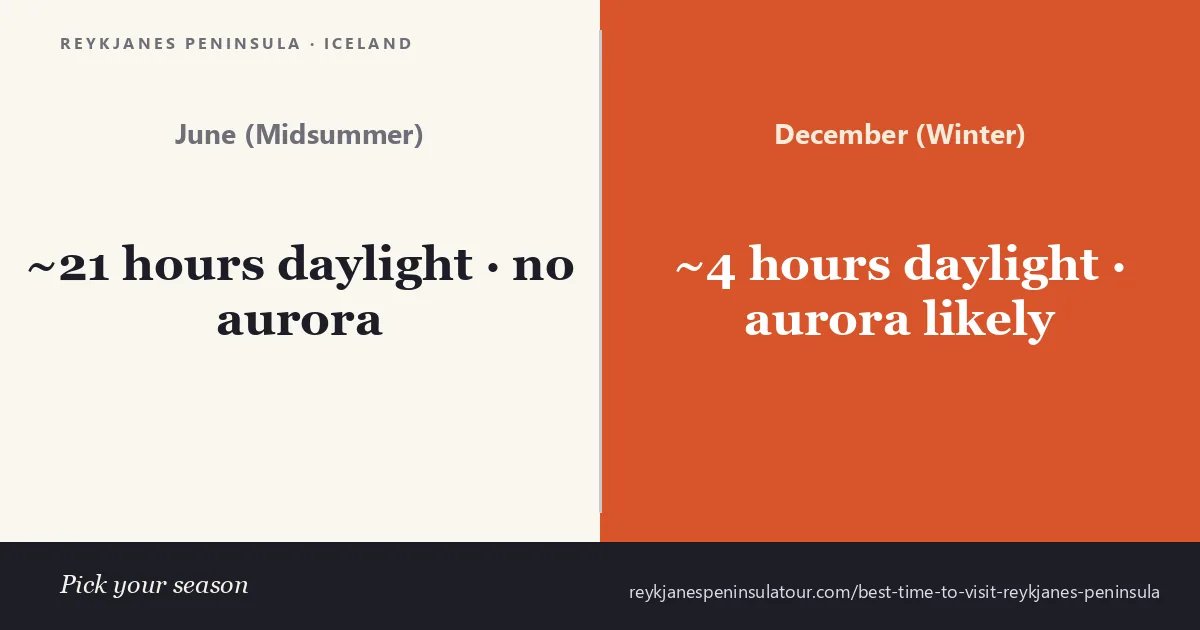
The headline draw is the light. Around the June solstice, the sun barely sets — it dips toward the horizon close to midnight and is back up roughly three hours later, giving you something like 21 hours of usable daylight. That means a Reykjanes hike can comfortably run late into the evening, and the low-angle midnight sun makes the lava fields glow. The catch: with skies never fully dark from roughly late May to early August, the northern lights are effectively impossible to see.
Winter (November–February): Short Days, Aurora Season
Winter flips the equation. Daylight shrinks to about four hours around the December solstice, climbing back to roughly nine hours by mid-February. Hiking is harder — icy lava, biting wind, and limited daylight mean the eruption-site walks are tougher and shorter-windowed, and a guided tour becomes more valuable for the road and condition calls.
But winter is northern lights season, and Reykjanes is well placed for it: the sparse population means very little light pollution, so you don’t have to travel far to find a dark sky. The peninsula’s location right next to Keflavík Airport also makes a quick volcano-and-aurora trip a smart use of a winter layover.
Shoulder Seasons (Autumn & Early Spring)
The equinox months — March, April, September, October — are an underrated sweet spot. You get a workable amount of daylight for hiking and dark enough nights for the aurora, with fewer crowds than midsummer. Weather is more unpredictable in these months, so build in flexibility.
Daylight and Aurora at a Glance
| Period | Daylight (approx.) | Northern lights | Hiking |
|---|---|---|---|
| Jun–Jul (midsummer) | ≈21 hrs | No (sky too bright) | Excellent, late-evening hikes |
| May & Aug | Long | Marginal | Excellent |
| Sep–Oct (equinox) | ≈11–13 hrs | Good | Good, fewer crowds |
| Nov–Feb (winter) | ≈4–9 hrs | Best, darkest skies | Harder, shorter window |
| Mar–Apr (equinox) | ≈11–13 hrs | Good | Improving |
What About the Volcanic Activity?
Eruptions don’t follow a season — they can begin at any time of year, and they can also pause for months (as in 2026, when no lava is currently flowing). So you can’t time a trip to “catch an eruption.” What you can count on year-round is the freshly transformed landscape and the Geopark sights. Whenever you go, check the Icelandic Met Office (vedur.is) and safetravel.is before setting out.
What to Wear, Whatever the Season
Reykjanes is exposed and windy in every month, so the packing list barely changes:
- Sturdy waterproof hiking boots — the lava is sharp and uneven year-round.
- Warm, windproof, waterproof layers, gloves and a hat — yes, even in summer.
- Water and snacks for the longer hikes.
- Sunglasses against wind-blown grit; in winter add traction aids for ice.
The single biggest weather factor here isn’t temperature — it’s wind, which is relentless on the open lava and can make a mild day feel bitter. Layer accordingly.
So, When Should You Go?
- Want the easiest hiking and longest days? June–August.
- Want the northern lights? September–March, ideally on a clear, dark night.
- Want both daylight and aurora, with fewer crowds? Aim for the equinox months — late September or April.
Ready to Book?
Whatever season you choose, a guided tour handles the driving, the daily safety calls, and the geology. See the featured Reykjanes Peninsula tour (from $132, rated 4.6/5 by 1,137+ travellers) and check live availability.
See Iceland's Youngest Lava — From Reykjavík
Join 1,137+ travellers who rated this Reykjanes Peninsula tour 4.6/5. Eruption sites, the Mid-Atlantic Ridge, Gunnuhver hot springs, and round-trip transfer from Reykjavík — all with free cancellation.
Check Availability & Book